
Turkish phrases for everyday life in Turkey – what to say and what you'll hear
The Turkish phrases you need for everyday life in Turkey fit on one page: a few polite words, how to ask a price, one line for the dolmuş and a few for when the boiler breaks. What most phrase lists leave out is the other half of the conversation – the set phrases Turks reply with. Below are the most useful Turkish phrases for expats, with pronunciation and audio, grouped by situation, plus the replies you'll hear back.
Pronunciation is spelled the English way. A few letters to know: ş is "sh", ç is "ch", c is "j", ı (no dot) is a short "uh", and ğ is silent – it just lengthens the vowel before it.
Everyday Turkish phrases you'll use daily
Greetings change with the time of day – see hello in Turkish. In shops the short Teşekkürler or Sağ olun is more common than the long thank-you; more in thank you in Turkish.
At the shop, the market and the café
Asking the price is easy; catching the answer is harder. Prices come fast and usually without the word "lira": yüz elli is simply 150. If you miss it, ask Yazar mısınız? (ya-zar muh-suh-nuhz?) – "Could you write it down?". How Turkish numbers and prices sound is covered in Turkish numbers.
Getting around: dolmuş, taxi and bus
Müsait bir yerde is the phrase for the dolmuş: it stops on request, so say it just before your stop. For taxis, show the address on your screen.
At home: repairs, deliveries and neighbours
Sooner or later you'll talk to an usta (repairman), a courier and the people next door.
Ellerinize sağlık – "health to your hands" – is what you say when a neighbour brings food over or the repairman finishes the job. It goes down far better than a plain thank-you.
What you'll hear back: replies worth recognising
Most phrase lists stop at what you say. These are the lines you'll hear every day – and several have a fixed reply.
Buyurun is the Swiss army knife of Turkish politeness: you'll hear it with your change, at a shop door or as "what would you like?". Just say what you want. Kolay gelsin you can say yourself to anyone at work – the grocer, the cashier, the builder next door. It always earns a smile.
When something goes wrong
Turkey's single emergency number is 112 – ambulance, police and fire. At night and on Sundays one duty pharmacy, the nöbetçi eczane, stays open in each area; the other pharmacies usually post which one in their window.
How to make the phrases stick
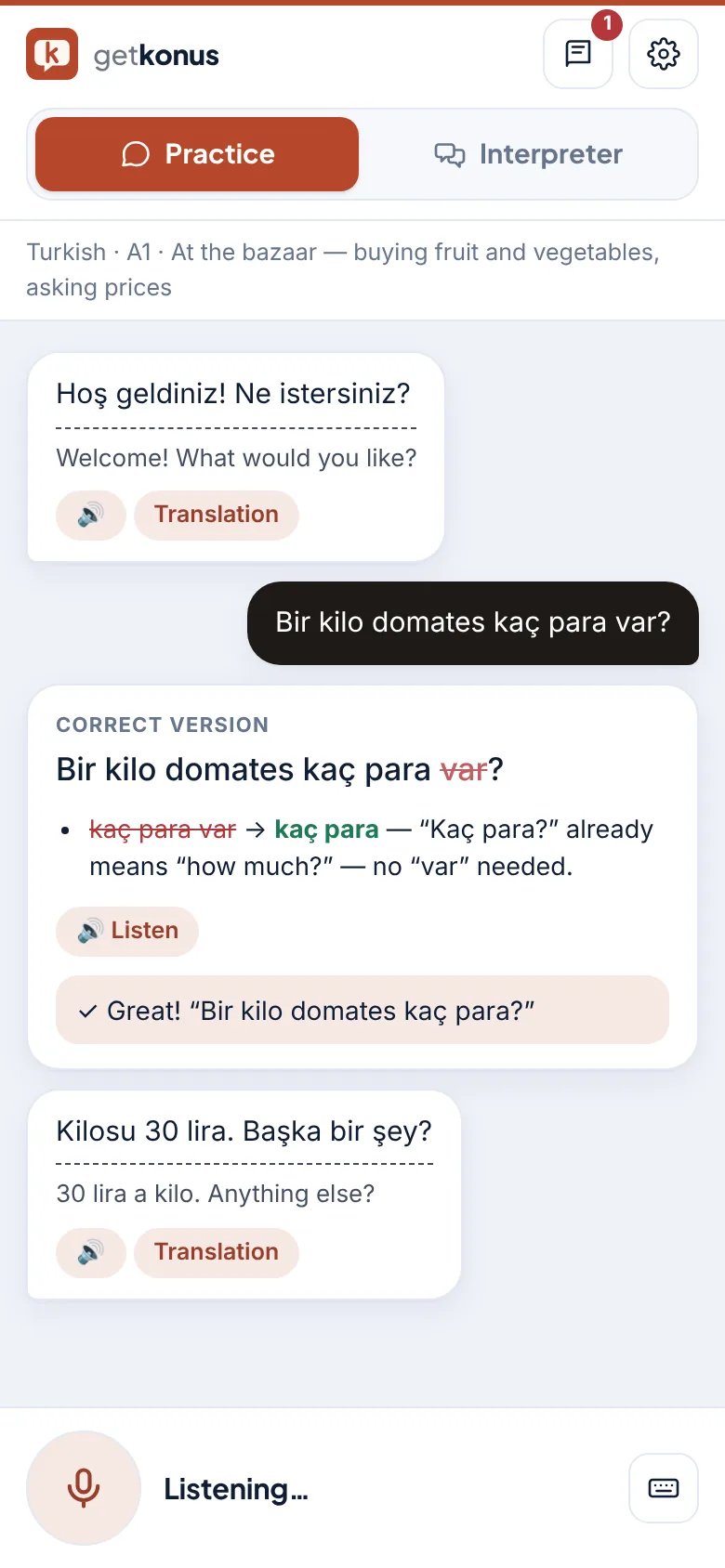
A phrase you've never said out loud won't come in the moment. So rehearse: before you head out, say two or three phrases for wherever you're going. Or practise properly – in Konuş you speak Turkish with an AI that plays the waiter, the taxi driver or the market seller. It corrects each of your sentences, repeats it the right way and explains the mistake in English – then the conversation carries on. It runs in your phone's browser and is free; during the current test phase you get up to 40 sentences a day.
Frequently asked questions
What are the most useful Turkish phrases for expats?
Merhaba (hello), Teşekkür ederim (thank you), Lütfen (please), Bu ne kadar? (how much is this?), Anlamadım (I didn't understand) and Kolay gelsin for anyone at work.
How do you reply to "Hoş geldiniz"?
The set reply is Hoş bulduk (hosh bool-dook), roughly "we found it pleasant". Use it in shops, at a hotel and when you arrive at someone's home.
What does "buyurun" mean?
A polite "please, go ahead". You'll hear it when someone hands you something, invites you in or asks what you'd like. Just answer with your request, or Teşekkürler.
Do people in Turkey speak English?
In resort towns and big hotels, often. At the pharmacy, the tax office or with a plumber, much less. To ask, say İngilizce bilen var mı?