
How to say hello in Turkish – and what to say back
Hello in Turkish is Merhaba (mehr-ha-ba); with friends, people say Selam (seh-lahm). Merhaba works almost everywhere – at the corner shop, the doctor's, with your neighbour. What surprises most newcomers is what comes next: many Turkish greetings have a fixed reply, and knowing it makes you sound far less like a tourist. Below are 12 greetings with pronunciation and audio, a quick cheat sheet and the mistakes English speakers make most often.
Hello in Turkish: merhaba and selam
Merhaba is the all-purpose word: you can use it with the shopkeeper, a bank clerk or a friend. Selam is more relaxed – with an older stranger, start with Merhaba. The h is only lightly breathed, so in fast speech it often sounds like "meraba". In text messages you will see slm and mrb.
Good morning, good afternoon, good evening
Günaydın is used until roughly midday. İyi günler and İyi akşamlar, on the other hand, are heard most often when people leave – as a parting wish. So when you walk into a shop, say Merhaba; on the way out, İyi günler.
A few sounds to know: ı (no dot) is a short "uh", ü is like the French "u" (round your lips and say "ee"), ş is "sh" and c is "j" as in "jam".
Greetings with a set reply
This is where Turkish differs most from English: some greetings have one expected answer. Learn them in pairs.
Hoş geldiniz – Hoş bulduk. When you arrive at your in-laws' or step into a small shop, you will hear Hoş geldiniz. The right answer is Hoş bulduk, not "thank you". It is a small thing, but it almost always gets a smile.
Kolay gelsin is very Turkish. You say it to the cashier, the plumber, the building caretaker or a neighbour fixing his car – often instead of hello. You will usually get Sağ ol or Sağ olun back; there is more on those in our guide to thank you in Turkish.
After hello: how are you?
Nasılsınız? nearly always follows Merhaba. Nobody expects a long answer – İyiyim, teşekkürler is enough. Just remember to ask back with Siz? (polite) or Sen? (informal).
Cheat sheet: who gets which greeting
| Situation | What to say |
|---|---|
| Shopkeeper, waiter, cashier | Merhaba |
| Doctor, official, older neighbour | Merhaba or İyi günler |
| Friends, colleagues, people your age | Selam |
| Morning on the stairs | Günaydın |
| Someone working | Kolay gelsin |
| Someone says Hoş geldiniz to you | Hoş bulduk |
| Leaving | İyi günler / İyi akşamlar |
Common mistakes English speakers make
- **Opening with İyi günler.** Not wrong, but it sounds more like goodbye. Walk in with Merhaba.
- **Replying "thank you" to Hoş geldiniz.** The reply is Hoş bulduk.
- Reading ı as "i". Nasılsın is "nah-suhl-suhn", not "nah-sil-sin".
- **Using Selam with older strangers.** It can feel too casual; Merhaba is the safe choice.
On body language: men usually shake hands, and close friends often hug. With women, it is best to wait and see whether she offers her hand first. On religious holidays younger relatives kiss the hand of elders and touch it to their forehead – nobody expects this from a foreign guest, but a warm Merhaba always goes down well.
Making it automatic
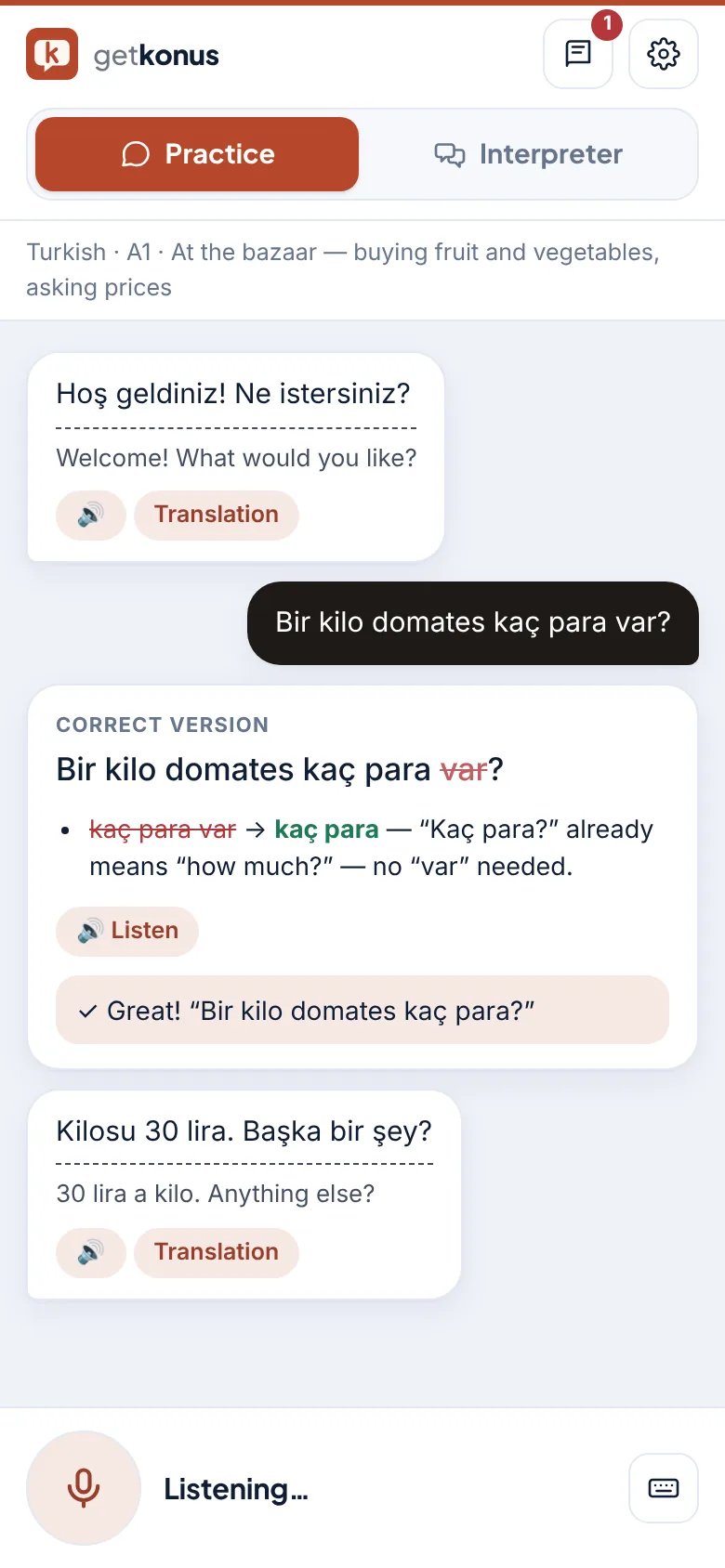
Knowing a word and saying it at the right moment are two different things. What helps is a short scene spoken out loud: walk into a shop, greet, ask, thank, leave. In Konuş you can practise exactly that with an AI conversation partner: you speak Turkish, it corrects every sentence, explains the mistake in English and keeps the conversation going. The app is free and currently in a test phase, with up to 40 sentences a day. More short guides are collected under Turkish for everyday life.
Frequently asked questions
How do you say hello in Turkish?
Merhaba (mehr-ha-ba) – neutral and fine everywhere. With friends, Selam (seh-lahm).
How do you say good morning in Turkish?
Günaydın (gew-nai-duhn). It is used until about midday.
What do you reply to "Hoş geldiniz"?
Hoş bulduk (hosh bool-dook) – the set reply to "welcome".
Can a non-Muslim say "Selamün aleyküm"?
Yes, it is a polite traditional greeting, heard mostly from older men. The reply is Aleyküm selam. In everyday life, though, Merhaba is all you need.
What does "Kolay gelsin" mean?
"May it be easy for you." It is said to someone who is working. The usual reply is Sağ ol or Sağ olun.